Bookmark this page - Use keyboard short-cut: Ctrl+D - For Your Benefit
Advisory
Use the Google Chrome web-browser to play the interactive crossword puzzles displayed on Indyword.com.
Specially when you are using a mobile device, like a smartphone or tablet.
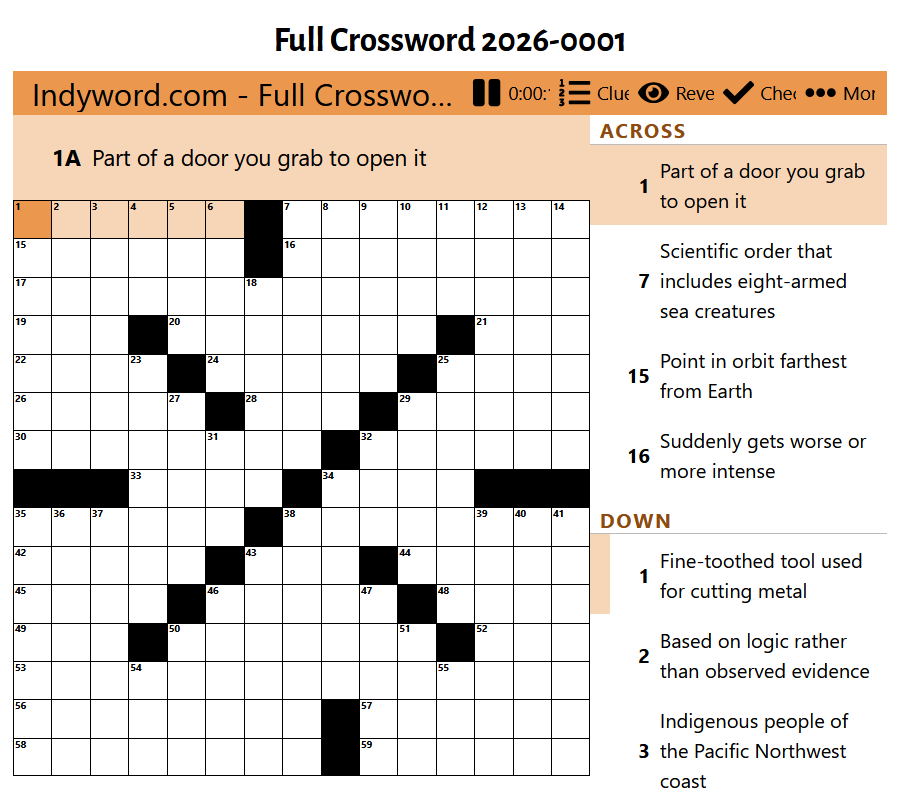
Full Crossword 2026-0001
Full Crossword 2026-0001
A note from me Frank Heymans, the creator of this crossword puzzle:
I created this crossword for people who enjoy slowing down, following words with care, and finding small moments of clarity along the way. I wanted this puzzle to feel thoughtful, calm, and satisfying to complete.
About this crossword:
When I made Full Crossword 2026-0001, I wanted it to feel like a steady and rewarding solve. I enjoy puzzles that give you a mix of familiarity and surprise, where one answer unlocks another and the whole grid slowly begins to breathe. My hope is that this crossword gives you a quiet moment of focus, curiosity, and satisfaction.
This is:
- a quiet solving experience
- a moment of focus
- the pleasure of discovery
- the feeling of the grid opening up
I make crosswords because I love the way words can create both challenge and calm. For me, a good puzzle is not only something to solve. It is also a small space to think, feel, and reconnect with curiosity.
Book:
Puzzle Mania!: Wordle, Connections, Spelling Bee, Minis and More! (New York Times Games Books) Hardcover – October 21, 2025 - Click Here
The Seedbeds of Atacama House
A short story
inspired by the clue list from Full Crossword 2026-0001.
Created by Frank Heymans - Saturday, 04 April 2026
Sometimes a crossword leaves a mood behind. While working on this puzzle, I felt there was a story hidden inside its clues. The Seedbeds of Atacama House grew from that feeling.
The Seedbeds of Atacama House
When Mara first took the handle of the old front door in both hands, she thought the brass felt strangely warm, as if someone inside had only just let go. The estate agent had called Atacama House “a little eerie,” but Mara preferred the word hesitant, as though the place itself was unsure whether it wanted to be abandoned or remembered.
The house stood alone at the edge of the dunes, beyond the last road, almost off-line from the world. No signal. No neighbours. No noise except wind, sea, and the distant cry of birds wheeling in a loose choir over the shore. Below the cliffs, the tide had carved a narrow chute through the rock. Near it, stranded in a shallow pool, she spotted a sillago flashing like silver wire and, farther out, what looked like a group of octopoda drifting through kelp-dark water.
Mara had not come for beauty. She had come because her aunt Leda had died and left her this impossible property, along with a box of documents, a bent pen, and a note that said only: What is buried is not always gone.
Inside, the house was full of relics. A cracked targe hung above the fireplace. In the pantry she found a rusted hacksaw, a tin of oreo biscuits gone soft with age, and a shelf of botanical journals tied with ribbon that needed her to retie them before they spilled apart. On the dining table sat a carved wooden kit of gardening tools and, next to it, a ledger full of cross-references written in her aunt’s severe hand. Arrows, page numbers, names. Endless cross-references.
Leda had once been a marine biologist, then a collector of unusual plants, then—depending on whom one asked—a genius or a wiseacre. She had believed, a priori, that the natural world spoke in repeating forms: spiral, pod, wave, bloom, bone. Her notebooks mentioned apsides, tide cycles, whale migration, and the geometry of seed patterns. One page held a sketch of a bottlenose whale breaching beneath a black moon. Another contained a recipe for preserving fruit from a tree labeled mammee.
At dusk, Mara found the greenhouse.
It leaned behind the house like a secret too tired to stand upright. Many panes were cracked, but beneath the broken glass lay neat rectangular seedbeds, still carefully edged with stone. Most were dead. One held only weeds. One, somehow, held a clutch of pale green shoots that seemed to glow in the dimming light.
Tucked into the frame was another note.
Do not ban wonder from the method. Test it.
That sounded like Leda. Half scientist, half mystic, all command.
Mara spent the next days sorting the notebooks. She worked at the kitchen table in a minibus of sunlight that rolled from one room to another as the hours passed. She read about elvers slipping inland through estuaries, about anemone colonies opening with the tide, about spectre crabs vanishing in dry sand. She found receipts from Harrods, shipping labels marked U.D.I. and I.M.C., and coded entries that meant nothing to her: C.B.S., S.L.S., C.B.T., H.M.G. Perhaps shipping firms. Perhaps private jokes.
The stranger parts unsettled her. Leda wrote of a red flower that flares up only under starlight. Of spores carried by a desert fox—“a tod, but not local.” Of sailors who once traded araks and shells along this coast. Of children who saw shapes in the mist and called them saints, kings, monsters. On one page Leda had copied a line from Virgil and underlined the name Aeneas three times.
Mara would have dismissed it all as the romantic excess of a lonely woman, but then she found the trapdoor under the greenhouse floor.
It took the hacksaw to cut through the swollen latch. Beneath lay a narrow stair spiraling down into cool earth. She hesitated, lantern in hand, listening. Nothing. Only the faint drip of water and, once, a low hollow sound like breath moving through an osculum in a sponge.
At the bottom was a chamber lined with shelves. Jars. Pressed plants. Bones. Coils of rope. A locked trunk labeled CHATTEL in black paint. A wall map pinned with coloured thread. And on a central table, under glass, a seed the size of a child’s fist.
It was not beautiful. It was knotted, dull, almost ugly, with ridges like scar tissue. Yet something about it held her gaze. Its shape suggested both shell and heart. Around the base of the glass case Leda had carved words into the wood:
Not rare because hidden. Hidden because people shames what they cannot name.
Mara stared so long that the lantern flame began to gutter. At last she opened the case.
The seed was lighter than she expected. Dry, but not dead. As soon as her fingers closed around it, memory came—not hers, but a rush of borrowed sensation: salt spray, burning skies, rough voices, a woman laughing, a child running between crates, someone saying “plant it where sea mist meets heat.” Then darkness. Long waiting. Years without count.
She almost dropped it.
Instead, she carried it upstairs and placed it in the center seedbed of the greenhouse.
For three days nothing happened. Mara watered the soil sparingly. She slept badly. She dreamed of Nootkas in cedar canoes, of women in market streets weighing fruit, of foxes carrying stars in their mouths. On the fourth night she woke before dawn and saw a light pulsing through the cracked greenhouse panes.
The seed had opened.
Not with a flower, not exactly. A stalk had risen waist-high, pale at first, then blushing deeper and deeper until it stood before her unrouged, naturally crimson, like colour arriving at its own apogee. Along its stem were folded leaves so fine and quick they seemed almost nimbler than her eyes. At the crown burned a bloom the size of two hands, shaped like a sea creature and a flame at once.
It smelled of resin, rain, and something older than either.
By noon the bloom had drawn half the coast to the house. First came Tomas, the fisherman, who had been sure Mara would sell and leave. Then his sibs, then two local masons, then a teacher with her testees in tow, then people from the village who had never crossed the dunes before. They stood in the greenhouse in respectful silence. No one mocked. No one called Leda mad.
An old woman at the back whispered, “Saint’s lantern.”
“No,” Mara said, surprising herself. “Not a saint. Just a plant. Just a thing we forgot how to see.”
But she knew that was not fully true. Science would have to input itself here, certainly. Samples, records, dating, classification. Yet wonder had entered the room first, and for once it did not need to apologize.
By evening, the flower had begun to close. Mara feared it might die as suddenly as it had appeared, but at its base she found a cluster of smaller pods forming, each one viable, each one a promise. Not one miracle. Many.
She thought of Leda, writing alone by lamplight, fighting to eke out meaning from patterns no institution would fund. She thought of all the things dismissed as too odd, too local, too feminine, too old, too much. Of knowledge left to dry because it did not fit the approved shelves.
Outside, the wind shifted. Over the sea, a whale breached—a dark arc against silver—and vanished again.
Mara smiled.
Atacama House was no longer hesitant.
It had spoken. And now, at last, someone was listening.
You might like these
Indyword Crosswords Index
The crosswords index page contains the link to each crossword on indyword.com
Easy Crossword About Flowers
An easy beginners crossword to print - Click here to play.
Mini Crossword Printable PDF | Printable 5x5 Crossword Book
Mini Crossword Printable PDF-Fun and addictive 5x5 mini crosswords. 25 printable puzzles. Perfect for adults, teens, travel, and daily brain workouts.
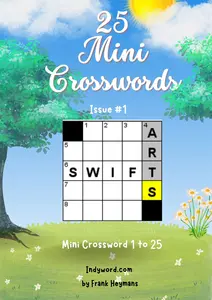
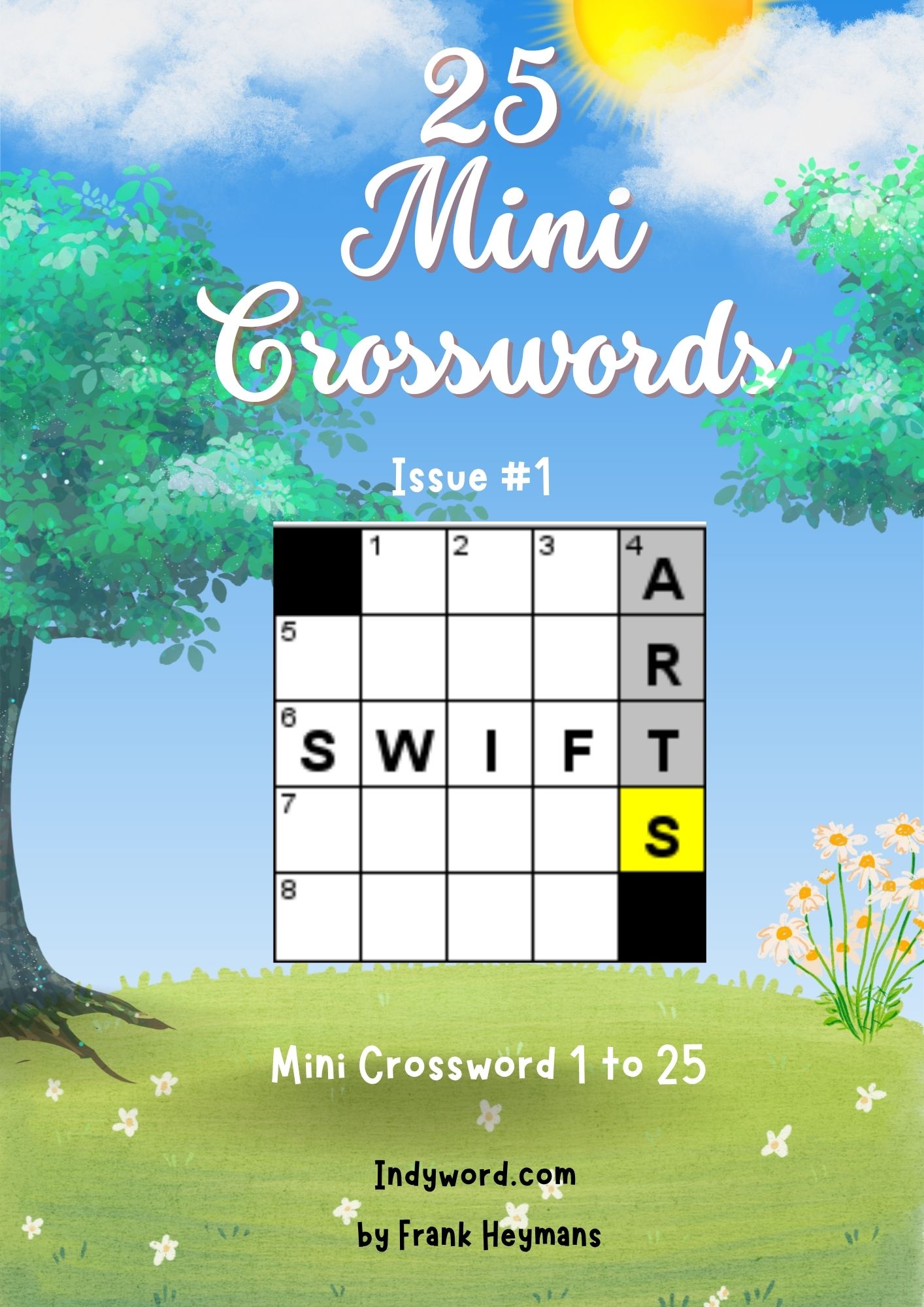
Get 25 New Mini Crosswords - Printable PDF packed with fun 5×5 puzzles. Perfect for travel, coffee breaks, and daily brain exercise.
Download Instantly
When you sign-up for the Indyword Crossword Puzzle Newsletter, you will be able to download a free copy of the "30 Easy Free Printable Crosswords" e-book. You will receive the link in the e-mail which I send you, to thank you, after we receive your confirmation. Sign up it's only a click away and takes just a minute!
Click Here to Join the Indyword Community and become a Member.
Thank you for believing in me and helping IndyWord thrive! 😊

Recent Articles


-
Welcome to Indyword | Free Online Crosswords, Printable Puzzles
 Play free crossword puzzles online or print them at Indyword. Explore mini crosswords, easy puzzles, and printable PDF crossword fun.
 -
Full Crossword 2026-0001
 Full Crossword 2026-0001 delivers a balanced mix of clever clues across everyday language, science, and culture. A satisfying challenge for curious minds.
 -
Mini Crossword 80
 Mini Crossword 80 – A warm scent drifts through the air, wrapping the senses in comfort and memory, making the moment feel instantly welcoming.



Free Copy of the "30 Easy Free
Printable Crosswords" e-book
Indyword Crossword Puzzle Newsletter
If you enjoy thoughtful crosswords, quiet wordplay, and the occasional surprise, you are welcome to join my newsletter. I would love to share new puzzles and creative updates with you.
When you sign-up for the Indyword Crossword Puzzle Newsletter, you will be able to download a free copy of the "30 Easy Free Printable Crosswords" e-book. You will receive the link in the e-mail which I send you, to thank you, after we receive your confirmation. Sign up it's only a click away and takes just a minute!